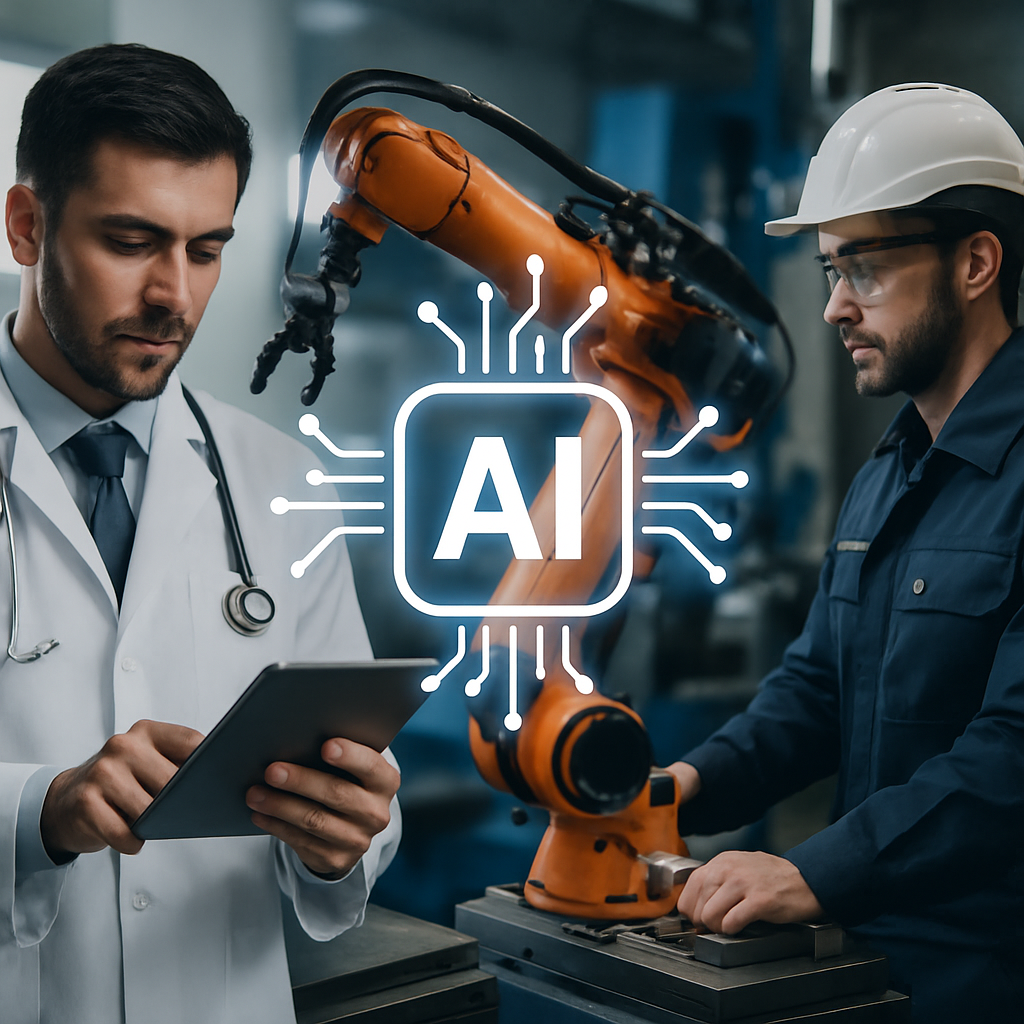
When we talk about artificial intelligence, many people think first of conversational assistants, personalized recommendations or advertising systems. But the reality is much broader, with AI already deeply embedded in key sectors, transforming businesses, processes and decision-making, often without a major media spotlight, but with concrete, measurable results.
At Globalia, we believe that AI is first and foremost a strategic tool, not a futuristic promise, but an ability to reveal value where no one was looking for it before.
In manufacturing, reading operations on an unprecedented scale
In the manufacturing industry, artificial intelligence today enables operations to be analyzed at a level of detail and continuity that was simply impossible before.
In Canada, AI adoption is progressing rapidly. For example, in 2025, more than 12% of companies used AI to produce goods or provide services, a rate that more than doubled in one year in Canada, reflecting an acceleration in the integration of AI into industrial operations. (Wikipedia)
In many factories, AI is used to :
- continuously analyze machine-generated data (vibration, temperature, pressure) to detect anomalies invisible to the human eye ;
- automatically identify manufacturing defects with machine vision systems, reducing inspection costs by around 23% in some cases observed in Canada (Business and industry Canada)
- cross-reference production, quality and maintenance data to understand the real causes of inefficiencies;
- optimize production planning based on real data, rather than static rules.
Here again, AI does not replace the expertise of production or maintenance teams. It radically increases their analytical capacity, enabling a continuous, granular and objective reading of operations, a reading that would be unattainable on this scale without AI. (Industrial Intelligence)
In healthcare, AI at the service of diagnostics and clinical performance
In the medical field, AI is already much more than just a research topic:
Diagnostics and medical imaging
AI is used to automatically analyze X-rays, MRIs and other imaging tests, improving diagnostic accuracy and speeding up interpretation times, which can reduce patient treatment times. (globalsante.org)
Predictive maintenance of medical equipment
Hospitals are now exploring the use of AI to analyze operating data from their equipment (such as X-ray machines) to predict failures before they occur, reducing downtime and maintenance costs. (journals.enfoundations.com)
This transformation is not science fiction; several academic publications and scientific papers show that AI can predict equipment failures and optimize maintenance schedules in real clinical environments. (Springer Nature)
In industry, better quality, fewer breakdowns, greater efficiency
In the industrial world, AI is no longer just an option, it is becoming a strategic lever for competitiveness:
Automated quality control
Thanks to computer vision, intelligent systems continuously inspect the quality of parts and finished products, detecting subtle defects far more quickly and accurately than conventional human inspection (DZone)
Predictive maintenance
By analyzing sensor and machine data, AI anticipates maintenance needs, minimizing downtime and extending equipment life. (mdpi.com)
These uses are no longer prototypes, they are being deployed by manufacturers to reduce operating costs, maximize production line efficiency and improve customer satisfaction. (CMM QUARTERLY)
What these cases have in common, and what every decision-maker needs to remember
The examples above demonstrate a clear truth: AI creates value when applied to real, measurable and strategic problems, not just abstract concepts.
And this value manifests itself in three ways:
- Increasing human capabilities
AI enriches existing expertise such as agronomists, clinicians and engineers, without replacing them. - Faster, better-informed decision-making
Organizations that harness data with AI make more accurate, faster and better-informed decisions. - Increased operational efficiency
In sectors where every minute counts - healthcare, production, logistics - AI reduces waste, delays and inefficiencies.
A roadmap for decision-makers
For a decision-maker, AI should be seen as a strategic toolbox, not a technological gimmick:
- Identify critical friction points in your operations (e.g. diagnostic delays, frequent breakdowns, inconsistent quality).
- Formulate measurable hypotheses (e.g. 10% reduction in diagnostic errors, 20% reduction in machine breakdowns).
- Pilot low-risk AI projects before deploying them on a large scale.
- Ensure collaboration between business, tech and data science - AI performs when it's co-designed with business experts.
At Globalia, we see AI as a gas pedal of intelligent decisions, anchored in concrete utility, where the stakes are real, the data abundant and the gains tangible.